





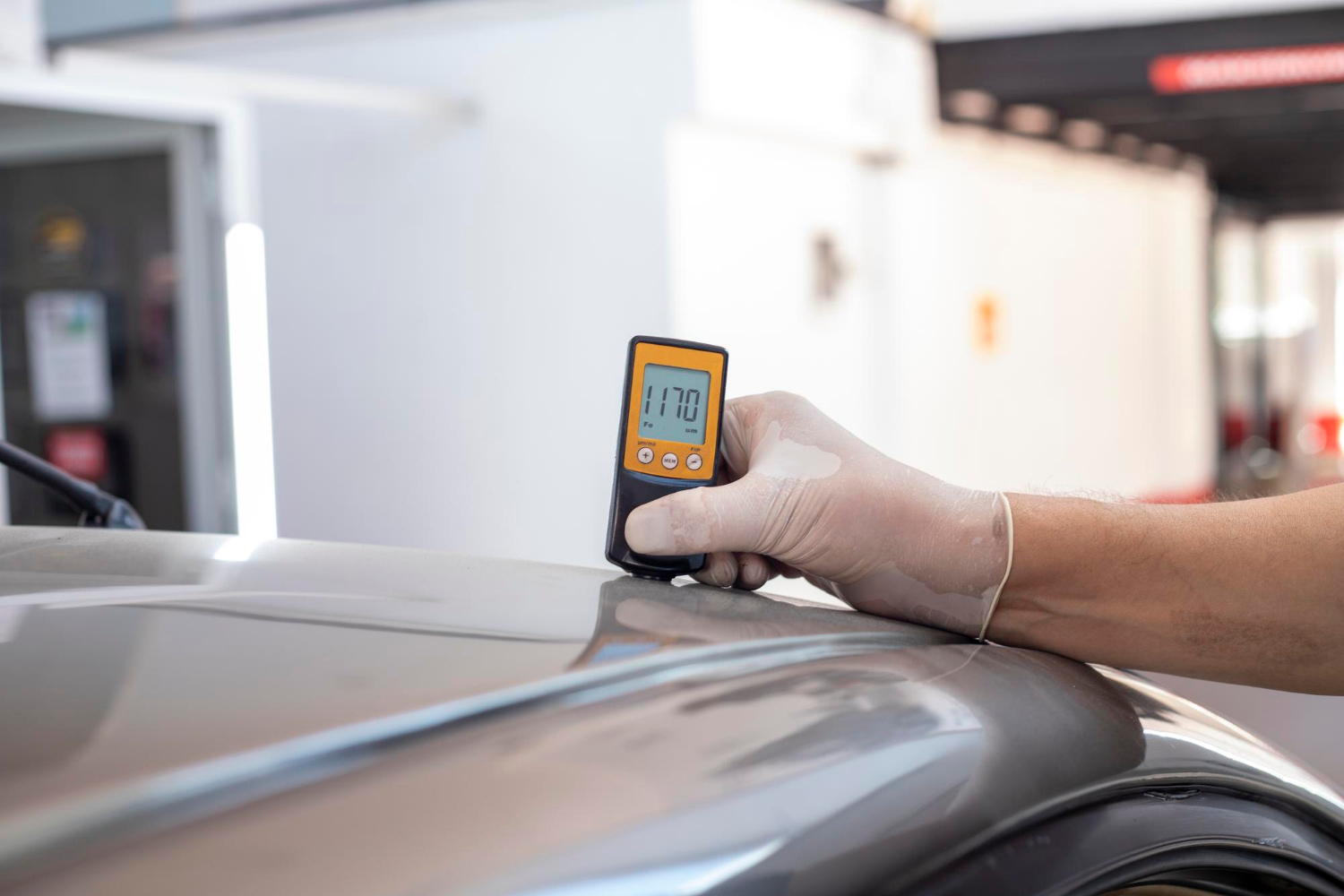
A paint thickness gauge measures the depth of the paint without contact, in micrometres (µm), using an electromagnetic or eddy current method. Original factory paint sits in a characteristic range depending on the manufacturer and component; clearly higher readings point to a respray or applied filler, which can be a sign of repaired accident damage. Conspicuously low readings can indicate a sanded-down surface or a replaced body part. The measurement offers no guarantee of detection, but it is one of the most reliable tools in a used-car inspection and crucially complements the visual check.
Independent · On-site · Own report · Fixed price
Paint Thickness Measurement: What the Gauge Really Reveals About a Used Car
A gauge that looks straight through the paint without touching it — and shows in seconds whether a body panel is original or has been reworked. Paint thickness measurement is one of the most reliable ways to uncover hidden accident damage and filler work on a used car. Here's how it works and what the readings mean.
4.9
Google · 39+ reviews
100+
Checked points
What is paint thickness measurement and what does it reveal?
Why a used car's paint reveals so much
A vehicle's paint is more than looks — it is a witness to the car's history. Accident repairs, touched-up hail damage or concealed theft damage almost always leave traces in the paint layer. A trained eye spots some of these traces: a slightly different shade, matte patches, visible paint seams along edges or an uneven surface texture. What the eye cannot see, the gauge measures.
Paint thickness measurement makes this invisible area visible. That is why it is a fixed part of professional used-car inspections and one of the most important tools when it comes to spotting undeclared accident damage.
How does a paint thickness gauge work?
Paint thickness gauges work according to two physical methods — depending on the substrate material:
Magnetic induction method (for steel bodies) An alternating magnetic field is directed into the surface. The distance between the sensor tip and the magnetic steel panel is directly proportional to the layer thickness. The method is very precise and suits most car bodies.
Eddy current method (for aluminium and non-ferrous metals) For aluminium panels, which are increasingly used in modern vehicles, a high-frequency alternating field is used to induce eddy currents in the substrate material. Here too, the signal response allows the layer thickness to be inferred.
Modern gauges detect the substrate automatically and switch methods accordingly. Each measuring point takes only seconds; an experienced inspector takes readings at ten to twenty points per body panel to build a representative picture.
What counts as standard values? (qualitative guidance)
There is no uniform regulation for the correct paint thickness — every manufacturer, every model and every production line produces slightly different values. As a guide:
- Factory paint from the works: depending on the manufacturer and year, usually between roughly 80 and 160 micrometres, consisting of primer, base coat, top coat and clear coat. Premium-class vehicles tend to sit at the upper end of this range.
- Respray without filler: resprayed areas often show values well above the original range — sometimes considerably so, depending on the number of paint layers.
- Filler under the paint: filler layers can push the total thickness to values far beyond typical factory figures. Readings of 400 µm or more point to larger filling work.
- Values that are too low: heavily sanded spots — for example after polishing or a surface blending — sit below the factory range. A replacement part that was painted only after being fitted can also show slightly different values.
What matters is not a single value, but the pattern across all measuring points. A reading on a single wing that is conspicuously higher than all the other panels is far more suspicious than a value that is uniformly slightly elevated across all surfaces.
What does a conspicuous reading actually reveal?
Respray
A respray means a panel has been repainted after leaving the works. That can have cosmetic reasons (scratches, small dents) or point to a repaired accident. Resprays are not inherently a problem — what matters is whether the damage was repaired fully and properly, and whether it is being concealed from the buyer.
Filler
Filler points to larger deformations that could not be remedied with body tape or pulling techniques alone. The thicker the filler layer, the more extensive the panel damage usually was. Thick filler can crack or peel off after a few years — a long-term loss of quality.
Replacement part
When a panel was replaced rather than repaired after an accident, the reading is often within or just above the factory range — provided the replacement part was fully built up again by a paint shop. Here the panel gap check and a comparison of the spot-weld pattern on the underbody help further.
Your car gets X-rayed. More than 100 points. Systematic.
Paint measurement & accident detection
Using digital ultrasonic paint-thickness measurement, we expose filler, repaints and hidden accident damage down to the millimetre.
Comparison against the manufacturer's target values at 12+ measuring points.
OBD diagnostics
Reading out all fault memories and plausibility check of the mileage.
Detects odometer tampering, control-unit faults and deleted warnings.
Engine & drivetrain
Visual and acoustic inspection of engine, transmission and drivetrain.
Leaks, belt tension, smoothness and transmission behaviour under real conditions.
Market-value analysis
Based on the repairs factored in, we calculate the actual market value.
Data basis: ~50,000 comparable listings from the last 90 days.
What paint thickness measurement cannot do
The measurement is a strong indication, but not proof. It shows that something is not original — not why. A scratch that was professionally touched up leaves elevated readings just as a repaired front-end impact does. Judging whether a finding is relevant to the purchase price requires the assessment of an experienced vehicle inspector, who brings together readings, visual findings, panel gaps and the vehicle's history.
Also: carbon-fibre or GRP trim parts (e.g. spoilers) cannot be measured with the standard method. Here the inspector has to rely on visual clues.
Taking the paint measurement yourself — is it worth it?
Basic gauges are available for under 100 euros. The measurement itself can be learned after a short familiarisation. What the layperson often lacks, though, is the experience to interpret the readings of a specific model correctly. A reading of 200 µm can be very conspicuous on a compact-class vehicle, yet less of a concern on a German premium model with several base-coat layers.
Anyone buying a vehicle in the higher price segment, buying privately without a warranty, or simply without the time to operate the gauge properly is better served by a professional on-site inspection. The inspector brings the gauge, knows the reference values and can place the findings in context straight away.
Paint measurement as part of the checkdenwagen Premium inspection
Paint thickness measurement is a fixed part of the checkdenwagen on-site inspection. The inspector measures all the relevant body panels, documents every finding with readings and photos, and explains in the written report what the values mean. That gives you a factual basis for the purchase decision — or for negotiating the price if a defect is uncovered.
Found the car you want? Have it inspected before you buy.
Our inspector comes straight to the seller — fixed price from 289 €, report within 24 h.
Frequently asked questions about paint thickness measurement
The gauge measures the total thickness of all paint layers above the base material (steel or aluminium) in micrometres. It does not distinguish between primer, base coat, clear coat and filler — it gives you a combined figure. Working out which layers are suspiciously thick or thin, and why, takes experience.
Uncover paint damage before it becomes your problem.
checkdenwagen measures, photographs and assesses — right at the seller's place, for a fixed price.