





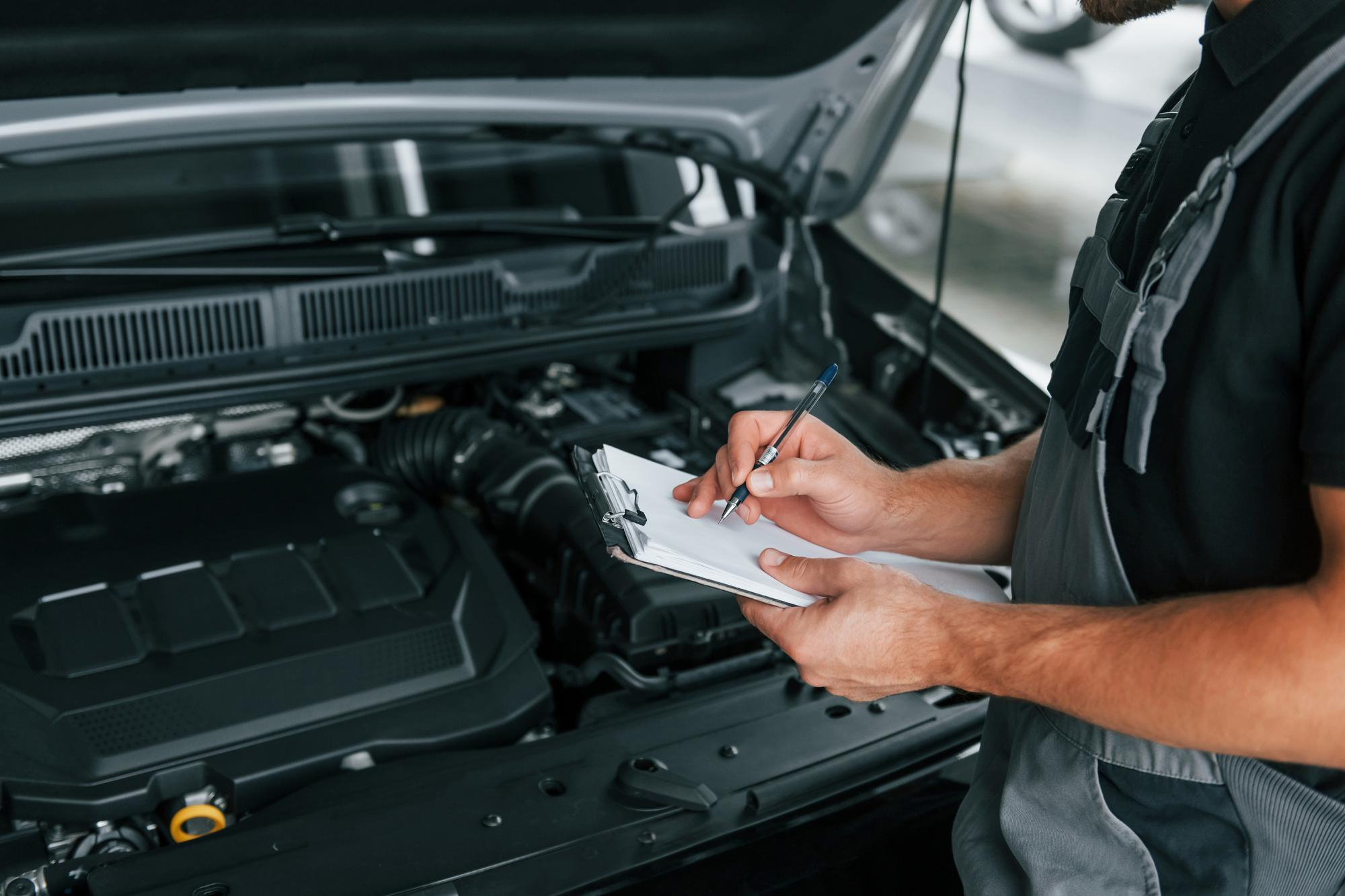
The fees for the Hauptuntersuchung are not set uniformly across Germany; instead they vary depending on the inspection organisation, region and vehicle class. For a car up to 3.5 tonnes permissible gross weight, the costs including the emissions test fall within a range that differs depending on provider and location. TÜV, DEKRA, GTÜ and KÜS each calculate their own fees, so a direct price comparison on the spot makes sense. On top of that: if defects are found, a chargeable re-inspection is required in many cases, which increases the total cost.
Independent · On-site · Own report · Fixed price
The Hauptuntersuchung: What the HU costs, what it checks — and where its limits lie
Every two years, cars must go for the Hauptuntersuchung. The fees vary depending on region and inspection organisation — there are no fixed prices. And despite a passed HU, a used car can have significant defects that become a costly trap at purchase. Here's what you need to know.
4.9
Google · 39+ reviews
100+
Checked points
What does the Hauptuntersuchung (HU) cost?
What is the Hauptuntersuchung — and who carries it out?
The Hauptuntersuchung (HU) is a legally mandated vehicle inspection in Germany. Its purpose is to ensure that vehicles taking part in road traffic are roadworthy and environmentally compliant. The legal basis is the Road Traffic Licensing Regulations (Straßenverkehrs-Zulassungs-Ordnung, StVZO).
The HU is carried out exclusively by officially recognised inspection organisations. In Germany, these are primarily:
- TÜV (several regional companies, e.g. TÜV Rheinland, TÜV Nord, TÜV Süd)
- DEKRA
- GTÜ (Gesellschaft für Technische Überwachung)
- KÜS (Kraftfahrzeug-Überwachungsorganisation freiberuflicher Kraftfahrzeug-Sachverständiger)
checkdenwagen.de is not an inspection organisation within the meaning of the StVZO and does not carry out Hauptuntersuchungen. checkdenwagen also does not issue any sticker. The used-car inspection is a voluntary inspection service that accompanies the purchase — we'll come back to that further down.
What does the Hauptuntersuchung cost?
In Germany, HU fees are not centrally fixed. Each inspection organisation calculates its own prices; on top of that come regional differences between urban and rural locations. Anyone looking for the cheapest provider should compare prices locally.
Broadly speaking, the following vehicle categories can be distinguished:
- Cars up to 3.5 t: fees including the emissions test vary depending on inspection centre and region
- Motorcycles and light motor vehicles: usually lower than cars
- Heavy vehicles (3.5 t to 7.5 t): significantly higher, as the inspection is more involved
- Motorhomes and trucks over 7.5 t: the highest fees; some of these vehicles must go for the HU every year
The costs for the HU and the emissions test are usually shown by the inspection centres as a single total. Experience shows that TÜV and DEKRA tend to sit in similar price ranges; smaller organisations such as GTÜ or KÜS may differ slightly — either way.
Re-inspection: If significant defects are found, the vehicle must be presented for a re-inspection after the repair. Fees apply for this too. If the presentation deadline is exceeded by more than two months, a supplementary inspection is added, which is charged with a surcharge.
What inspection intervals apply?
- New registration: for the first time after three years
- Cars and motorcycles: every two years thereafter
- Certain heavy vehicles and motorhomes: annually (depending on weight and age)
The next due date is shown on the inspection sticker on the rear number plate. The month and year are encoded in it: the number in the centre shows the due year, and the coloured segment indicates the month.
What is checked during the HU?
The HU is a safety- and environment-related inspection. In accordance with the HU guidelines, the inspection engineers check, among other things:
- the brake system (effectiveness and condition)
- the steering system
- lighting technology and the electrical system
- axles, wheels, tyres and suspension
- chassis, frame and body
- visibility (windows, mirrors)
- exhaust emissions (emissions test)
- vehicle identification (VIN check)
The inspection is carried out largely visually, manually and using measuring equipment — without disassembly. Not part of the HU are the internal workings of the engine and transmission, comfort and entertainment electronics, and cosmetic defects on the bodywork or interior, provided they do not impair road safety.
Your car gets X-rayed. More than 100 points. Systematic.
Paint measurement & accident detection
Using digital ultrasonic paint-thickness measurement, we expose filler, repaints and hidden accident damage down to the millimetre.
Comparison against the manufacturer's target values at 12+ measuring points.
OBD diagnostics
Reading out all fault memories and plausibility check of the mileage.
Detects odometer tampering, control-unit faults and deleted warnings.
Engine & drivetrain
Visual and acoustic inspection of engine, transmission and drivetrain.
Leaks, belt tension, smoothness and transmission behaviour under real conditions.
Market-value analysis
Based on the repairs factored in, we calculate the actual market value.
Data basis: ~50,000 comparable listings from the last 90 days.
Common defects during the Hauptuntersuchung
A significant proportion of the vehicles presented for the HU are flagged with defects. According to data from the Federal Motor Transport Authority (Kraftfahrt-Bundesamt, KBA) from past years, the most common types of defect include:
- Lighting technology and electrical system — defective headlights, incorrectly adjusted lights, failed bulbs
- Brake system — brake pad wear, corroded brake discs, reduced braking effect
- Axles, wheels, tyres and suspension — insufficient tread depth, damage to chassis parts
These defects are often the result of neglected maintenance. Anyone who has their vehicle serviced regularly and replaces wear parts in good time generally avoids surprises at the HU appointment.
What happens if the TÜV has expired?
If a vehicle with an expired HU is encountered on public roads, fines apply:
- Up to 2 months overdue: warning fine
- 2 to 4 months: increased penalty fine
- 4 to 8 months: a noticeable penalty fine and a point in the driving aptitude register (Flensburg)
- More than 8 months: the highest penalty fine in this category and a point in Flensburg
In addition, there are insurance-related consequences: in the event of a self-inflicted accident with an expired HU, the motor insurer may reduce its payout or seek recourse against the driver.
The HU and a used-car inspection: two different things
A common misunderstanding when buying a used car: a freshly passed HU is interpreted as proof of the vehicle's quality. It is not.
The HU checks only whether the vehicle meets the minimum requirements for road safety and environmental compatibility. It does not assess the general condition, the maintenance history, the degree of wear on the engine and transmission, body damage from accidents, or the vehicle's market value.
A vehicle can pass the HU and at the same time:
- have a repaired accident with structural weaknesses
- have an engine with increased oil consumption or developing engine damage
- have a tampered odometer reading
- show significant wear on the transmission, clutch or chassis
None of these problems is part of the HU. This is exactly where the used-car inspection comes in.
What a used-car inspection delivers — and what it doesn't
checkdenwagen sends an independent automotive appraiser straight to the vehicle — to the dealer, to a private address or to any other viewing location, anywhere in Germany. The inspector assesses the vehicle from the buyer's perspective: condition, maintenance history, signs of accidents, mechanics, electrics and documents.
Used-car inspection packages from €289 incl. VAT and travel.
checkdenwagen does not issue an HU sticker and does not carry out the statutory Hauptuntersuchung. The used-car inspection is not a substitute for the HU but a supplement from the buyer's perspective: it clarifies whether the vehicle is worth its price and what costs the buyer might face.
When a used car is listed with a fresh HU, it means: the vehicle is roadworthy enough to drive on the road. Whether it is also worth its money and free of hidden defects — only the independent on-site inspection answers that.
Found the car you want? Have it inspected before you buy.
Our inspector comes straight to the seller — fixed price from 289 €, report within 24 h.
Frequently asked questions about the Hauptuntersuchung and its costs
Passenger cars must go for their first Hauptuntersuchung three years after first registration, and every two years thereafter. The exact due date is shown on the inspection sticker on the rear number plate.
Dream car with a fresh TÜV? Have its condition checked independently anyway.
checkdenwagen comes straight to the vehicle — fixed price from €289 incl. VAT and travel, anywhere in Germany.