





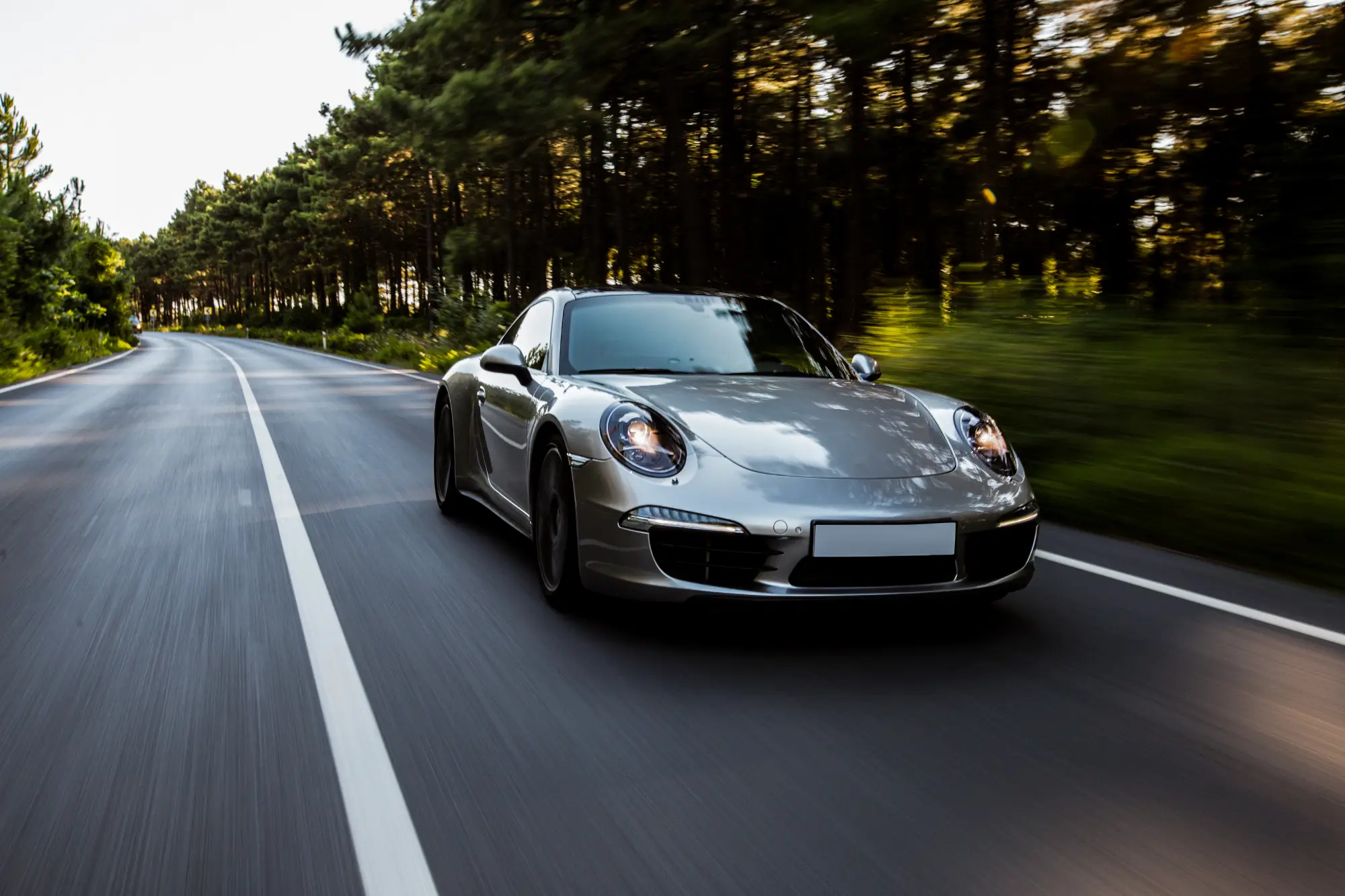
The Porsche Panamera is no ordinary used vehicle — it combines grand-tourer comfort with sports-car technology at a level that becomes correspondingly expensive in the event of a fault. checkdenwagen.de is an independent, Germany-wide provider of on-site used-car inspections, based in Berlin and with a network of inspectors across Germany. Our inspector comes directly to the vehicle's location — no towing, no workshop appointment, no sales pressure — and assesses your desired Panamera for around 1.5 hours against an inspection catalogue of more than 100 points. Particular attention is paid to the weak points that are decisive when buying a used Panamera: the condition of the air suspension (Air Body Control, compressor and air springs), the timing chains and camshaft adjusters of the first-generation (970) 4.8 V8 petrol, the condition of the E-Hybrid battery on hybrid variants, the service status of the PDK transmission (970) or the ZF 8-speed automatic transmission (971), and the elaborate comfort and chassis electronics of the second generation (971), including rear-axle steering. The result is a digital photo report with all findings — within 24 hours by email. A clear basis for your decision that you can use directly in price negotiations. Our USP: independent of the seller, transparent on price, on-site throughout Germany. Phone: 030 301 32 327.
Have a used Porsche Panamera inspected: on-site used-car inspection, from €289
The Porsche Panamera is a grand tourer with sports-car genes — and maintenance demands to match its premium claim. Air-suspension compressor, V8 timing chains, camshaft adjusters, E-Hybrid battery or the highly complex chassis electronics of the second generation: anyone who buys a used Panamera without an independent inspection risks expensive repairs that are invisible in the purchase price. Our inspector comes directly to the vehicle — 100+ inspection points, OBD diagnostics, paint-thickness measurement, digital report within 24 hours. From €289 incl. VAT and travel.
Buying a used Porsche Panamera: what really counts in the inspection
The Panamera inspection at a glance
100+ inspection points
Systematic inspection following a model-specific catalogue — air suspension, engine, transmission, chassis electronics, body, OBD readout and document situation.
Report within 24 hours
Digital photo report by email within 24 hours of the on-site inspection — annotated findings, paint thicknesses, OBD readout, overall rating.
From €289 incl. VAT
Fixed price from €289 (Standard) or €339 (Premium), each incl. VAT and travel. Full cost transparency before booking.
Independent of the seller
No interest in closing the sale. Our inspector works exclusively for you — no commission, no ties to dealer or private seller.
Panamera 970 vs. 971: what sets the two generations apart when buying used?
The Porsche Panamera was introduced in 2009 with the first generation (type 970) and replaced in 2016 by the thoroughly revised second generation (type 971).
Panamera 970 (2009–2016): The first generation offers V6 petrol engines (3.0), V8 petrol engines (4.8, in S and Turbo), the V6 TDI (3.0) and the S E-Hybrid hybrid variant. The PDK dual-clutch transmission is the dominant transmission concept. Typical weak points are concentrated on the 4.8 V8 (timing chains, camshaft adjusters — the same pattern as on the Cayenne 4.8 V8), the Air Body Control air suspension, the hybrid battery of the S E-Hybrid variant, and the PDK transmission service. The well-maintained V6 petrol is considered the more reliable choice among the entry-level engines. The V6 TDI is robust in principle but shows typical diesel issues with neglected oil changes and short-trip use of the particulate filter.
Panamera 971 (from 2016): The second generation is technically considerably more elaborate. V6 and V8 twin-turbo engines replace the naturally aspirated units; the hybrid range is greatly expanded with the 4.0 V8 E-Hybrid. The ZF 8-speed automatic transmission replaces the PDK. New dimensions of complexity are added by the optional rear-axle steering, the active chassis and the Porsche Communication Management (PCM 4.0). A higher new price also means a high level on the used market — but also repair costs that mirror this class. The air suspension and chassis electronics remain the most cost-intensive weak points.
Porsche Panamera: these are the weak points our inspection targets
Air Body Control air suspension — compressor, air springs, valve block
The Air Body Control air suspension is the heart of the Panamera's chassis and at the same time its most expensive wear component. The compressor, air springs and valve-block unit are wear parts whose failure shows up in characteristic symptoms: the vehicle sinks after being parked, builds up its level unevenly, or the air-suspension warning signal appears on the dashboard. A defective compressor or a split air spring can, depending on the component and generation, cost a high to very high three- or four-figure amount. Our inspector checks the system layout, watches for sagging after a cold start and inspects all visible lines and connections.
V8 timing chains and camshaft adjusters — Panamera 4.8 (970)
The 4.8 V8 petrol of the Panamera 970 (S, 4S, Turbo, GTS) shares its technical basis with the Cayenne V8 of the same era — and with it a known weak point: wearing timing-chain drives and camshaft adjusters that develop noises early on with neglected oil changes or prolonged operation on old oil. The characteristic rattling or clattering on a cold start is a warning sign. Our inspector deliberately listens to the cold start, reads out the engine control unit's fault memory and assesses the engine oil for condition and abrasion. An overlong oil-change interval in the service booklet is a direct risk signal on this engine.
PDK transmission (970) and ZF 8-speed automatic (971) — service and condition
The Panamera 970 uses the PDK dual-clutch transmission, the 971 the ZF 8-speed automatic transmission. Both are highly developed and reliable — when they are looked after. The PDK needs regular transmission-oil changes, which in practice are often skipped because the manufacturer talks of a 'lifetime fill'. Restless shifting, shift shocks under load or jolting when pulling away are typical signs of a neglected PDK. The 971's ZF 8-speed is considered more robust but likewise benefits from regular oil changes. Our inspector checks all gear ranges on the test drive, reads out the transmission control unit via OBD and checks the service history for documented transmission services.
E-Hybrid battery — capacity, charging behaviour and condition
Panamera versions with E-Hybrid drive (S E-Hybrid in the 970, 4 E-Hybrid and Turbo S E-Hybrid in the 971) carry a high-voltage battery whose capacity loss increases with age. A battery with severely reduced capacity means low electric range and frequent engine running — which negates the consumption advantage of the hybrid. More problematic is the failure of individual cells or module faults that require an elaborate battery repair or a battery replacement. Our inspector reads out the hybrid fault memory, checks the charging behaviour at a socket and assesses the OBD battery parameters for conspicuous values. Missing charging cables or gaps in the battery-maintenance documentation are additional warning signs.
Rear-axle steering and active chassis — Panamera 971
The second Panamera generation (971) offers, as an option, electric rear-axle steering as well as the active Porsche Dynamic Chassis Control (PDCC) — both systems that drive repair costs up sharply in the event of a fault. A defective rear-axle steering shows up in restless straight-line tracking or a fault message in the PCM. PDCC problems manifest as chassis noises or activation errors. Since these systems rarely come with documented repair histories on the used market, a thorough OBD readout of all control units is particularly important. Our inspector reads out all chassis control units and assesses conspicuous fault codes for plausibility.
V6 TDI (970) — particulate filter, injection system and EGR valve
The 3.0 V6 TDI in the Panamera 970 is a long-lived engine with well-maintained use — but is burdened by typical diesel issues when the vehicle has mainly been used for short trips. A clogged diesel particulate filter (DPF), worn injectors or a coked EGR valve are the most common consequences. Symptoms: increased soot emissions, engine stumbling in the lower rev range, fault codes relating to exhaust after-treatment. Our inspector reads out all engine-side fault memories, checks engine running across the entire rev range and evaluates the service history for mileage and usage profile.
PCM electronics and comfort systems — display faults, auxiliary heater, air conditioning
The Porsche Communication Management (PCM) is the Panamera's infotainment and control centre — and on older 970-generation model years a frequent failure candidate. A freezing system, a faulty reversing monitor or failed Bluetooth modules are known problems. Also conspicuous: Webasto auxiliary heaters with long downtime often show ignition faults on the Panamera, and air-conditioning compressors can develop sealing problems through infrequent use. Our inspector checks all comfort systems for function — air conditioning for cooling performance, auxiliary heater for ignition behaviour, and PCM for response and fault memory.
Brake system and PCCB — wear and costs on sporty variants
Panamera variants with carbon-ceramic composite brakes (PCCB) are technically impressive but extremely costly to replace when worn. Glazed, cracked or unevenly worn ceramic discs are an immediate replacement case. Even with steel brakes, sportily used Panamera examples show heat patterns and grooves that point to intensive use. A particularly important factor on the Panamera: the rear brake system, which is more heavily stressed than on comparable vehicles due to the high vehicle weight. Our inspector documents the condition of the brake discs and pads photographically at all four wheel arches and checks for signs of an intensive driving style.
Cooling system and gaskets — V8 engines and high mileage
V8 engines in the Panamera 970 generate considerable operating heat and place correspondingly high demands on the cooling system. At high mileage or when coolant changes have been missed, water-pump defects, thermostat problems and leaking hoses are common findings. The cylinder-head gaskets can also be affected if there is a history of overheating. Our inspector checks coolant level and condition, the operating-temperature curve via OBD, and watches for traces of overheating in the fault history as well as visible leaks at hoses and connections.
Which Panamera engine is the best choice when buying used?
The Porsche Panamera is available in both generations with a broad engine line-up — and the choice of powertrain has a considerable impact on the risk profile when buying used.
Panamera 970 — engine recommendation: The V6 petrol (3.0, in the base and 4) is considered the most reliable and easiest-to-budget choice in terms of running costs. It is free of the timing-chain problems of the 4.8 V8 and does without the hybrid complexity. Anyone buying the V8 (4.8, S, Turbo) should pay particular attention to timing-chain care and the oil-change history. The E-Hybrid requires a detailed battery assessment. The V6 TDI is an option with consistent long-distance use and complete maintenance — but a higher-risk vehicle in short-trip operation.
Panamera 971 — engine recommendation: The twin-turbo engines of both displacement levels (V6 and V8) are technically mature, provided oil changes have been carried out consistently. The twin-turbo V6 (2.9) is regarded as an uncomplicated entry point. E-Hybrid variants of the 971 have large battery packs — here an OBD readout of the high-voltage system is essential. Basic rule for both generations: a complete, documented service-booklet history with Porsche-workshop stamps and observed oil-change intervals is not an optional criterion on the Panamera but a necessary precondition for a sensible purchase.
What does a used Porsche Panamera cost — and what influences the price?
Even used, the Porsche Panamera is among the higher-priced vehicles — with a correspondingly high depreciation that makes it interesting for used-car buyers. At the same time, buying a cheap example does not necessarily mean a good deal if its technical condition explains the price level.
The most important price drivers on the Panamera are the engine, generation and equipment. Panamera 970 base variants with the V6 petrol are the most accessible in price; V8 S and Turbo variants cost considerably more but also carry higher repair potential. Panamera 971 models start at a considerably higher level on the used market but offer more modern technology and current safety systems.
What really determines the fair price: service history (complete vs. gaps), condition of the air suspension (checked and functional vs. known defects), mileage relative to the oil-change history, hybrid-battery condition on E-Hybrid variants, as well as tyre age and brake condition. A Panamera that looks attractively priced at first glance can conceal technical defects that later cost a multiple of the sum saved. In addition to the technical inspection, the Premium package of our check gives you a market-price assessment that shows you whether the asking price is realistic.
How your Panamera inspection works
Book online — in five minutes
Send us the vehicle location (postcode) and the listing link. Travel is included in the fixed price — no hidden costs. No phone call needed.
Inspector travels to the Panamera — around 1.5 hours on-site
An experienced vehicle appraiser from our Germany-wide network arranges the appointment directly with the seller and inspects your desired Panamera on-site for around 1.5 hours: OBD readout of all control units, paint-thickness measurement, engine check, air-suspension inspection, chassis, brakes, documents. You don't have to be there.
Digital report within 24 hours
You receive the complete inspection report by email: paint-thickness heatmap, OBD findings, photos of all defects and an overall rating per inspection category. Clearly structured, plainly worded — ready to use directly in price negotiations.
A purchase decision based on facts
Buy, negotiate or walk away — your decision, with complete information. The Premium package additionally gives you a market-price assessment and a follow-up phone consultation with the inspector.
What our customers say
“I had my 5 Series inspected before buying — the report was very detailed and made my purchase decision so much easier.”
Emre E.
Berlin
“When the vehicle wasn't available for the viewing after all, the refund was completely hassle-free. Very fair and transparent.”
Bartosz K.
Hamburg
“The Premium package gave me a clear overview of the expected repair and maintenance costs. Exactly what I needed.”
Amir O.
Munich
“Excellent knowledge of the German car market, the dealer landscape and price ranges. Highly recommended.”
Denis B.
Cologne
Porsche Panamera check in your city
Berlin
On-site used-car inspection in Berlin.
Learn moreHamburg
On-site used-car inspection in Hamburg.
Learn moreMünchen
On-site used-car inspection in München.
Learn moreKöln
On-site used-car inspection in Köln.
Learn moreFrankfurt am Main
On-site used-car inspection in Frankfurt am Main.
Learn moreStuttgart
On-site used-car inspection in Stuttgart.
Learn moreMore Porsche models
Porsche 911
Weak points & inspection for the Porsche 911.
Learn morePorsche Cayenne
Weak points & inspection for the Porsche Cayenne.
Learn morePorsche Macan
Weak points & inspection for the Porsche Macan.
Learn morePorsche Boxster
Weak points & inspection for the Porsche Boxster.
Learn morePorsche Cayman
Weak points & inspection for the Porsche Cayman.
Learn moreFrequently asked questions about the Panamera inspection
On the Panamera, the typical weak points are concentrated in a few but costly systems. First and foremost is the Air Body Control air suspension: the compressor, air springs and valve block wear with age and show up as sagging after the car has stood for a while, or as warning messages. On the 970 with the 4.8 V8, timing chains and camshaft adjusters are a known issue — identical to the Cayenne V8. E-Hybrid variants carry the risk of declining battery capacity. In the second generation (971), the highly complex chassis electronics, including optional rear-axle steering, are an expensive factor if something goes wrong. On top of that come PDK and ZF 8-speed transmission servicing, as well as the diesel particulate filter condition on the diesel.
Buy your Panamera on facts — not on gut feeling.
Air-suspension failure, worn timing chains, a depleted hybrid battery — the most expensive mistakes when buying a Panamera are invisible to the untrained eye. Our inspection gives you the facts. From €289 incl. VAT and travel.